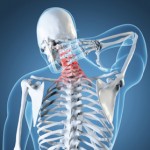
Acute neck and nerve-root pain describes several conditions that affect the cervical spine region, and can also cause head pain. In the long term, it is rarely as disabling as low-back pain, but the severity of acute nerve-root pain ca be just as bad as sciatica.
Neck Pain
Causes of Acute Neck and Nerve Root Pain
This pain can be caused by strain of the facet joints and ligaments, and disc herniation. Muscular pain is more of a chronic condition but can flare up. Your neck is also vulnerable to extend indirect trauma, as in whiplash syndrome. When acute neck pain arises spontaneously in young adults or adolescents it is called acute torticollis, or “wry neck”. Disc prolapse with nerve-root compression is the cause of the most severe pain.
Symptoms of Acute Neck and Nerve Root Pain
You may feel sharp pain, centrally or to one side of the neck, with intense, dull aching that can spread further into the shoulder blade area and half-way down the thoracic spine. You may have stiffness due to your spine being trapped by a muscle spasm (known as “splinting”), and worse pain on certain movements such as bending forwards, backwards, sideways, or rotating. You may also find it hard to sit in a car or at a computer for long periods. The pain is often troublesome at night and lying down may make it worse. If a nerve is compressed or irritated, a sharp pain will radiate down your arm as far as your hand, accompanied by sensory disturbance such as pins and needles or numbness. If your motor nerve fibres have been damages, you may develop weakness in your upper arm/or forearm.
Risks and Complications of Acute Neck and Nerve Root Pain
The risk of serious consequences of acute neck pain is extremely small. Most of the time the pain eases over a few weeks without specific treatment The main risk lies in too much rest, the fear of triggering pain through everyday movements, and the idea that more pain means further harm, as these can lead to loss of confidence and mobility. If you have developed pain after direct trauma such as a blow to the back of the neck, then you should obtain immediate medical advice.
Treatment for Cervical Disc Herniation
Seek Medical Attention
If you suspect your pain is caused by a cervical disc herniation, you should:
Relieve your pain by finding the least painful position.
Use ice pack for the first day of pain.
Take painkillers.
Try not to rest for more than 2-3 days.
If after 7-10 days and you are still feeling pain, you should:
Stay as active and mobile as you can, while being careful to avoid extreme movements of your neck.
Avoid prolonged reaching or working with your arms extended.
See a doctor for stronger painkillers.
If after 2-4 weeks and you are still feeling pain, you should:
Consult a doctor for further examination and treatment.
See a specialist for an epidural steroid or nerve-root injection.
If after 6-8 weeks and you are still feeling pain, you should:
You may need to have an X-ray, MRI or blood test for further evaluation.
Treatment for Acute Torticollis
Seek Medical Attention
If you suspect your pain is caused by acute torticollis, you should:
Use ice packs and take some painkillers
If after 3 days and the pain increases, you should:
Avoid prolonged static positions
If after 7-10 days and the pain increases, you should:
Consult a doctor for further examination, advice, or treatment.
If after 6-8 weeks and the pain increases, you should:
You may need to have an X-ray, MRI or blood test for further evaluation.
Treatment for Whiplash
If you suspect your pain is caused by whiplash, you should:
See a doctor to get your neck assessed to exclude more serious bone or nerve injury.
If after 7-10 days you are not able to resume normal activities, you should:
Consult a doctor for further examination, advice, or treatment.
If after 6-8 weeks you are not recovering as expected, you should:
See a specialist regarding the benefit from facet joint injections.
You may need to have an X-ray, MRI or blood test for further evaluation.
Minor neck injuries may result from tripping, falling a short distance, or excessive twisting of the spine. Severe neck injuries may result from whiplash in a car accident, or sports-related injuries.
“Burners” and “Stingers”
If you’ve played contact sports and suffered a burner or a stinger, you remember it. The pain shoots from the shoulder to the hand “like an electric shock or lightning bolt down the arm”. A burner or stinger is an injury to the nerve supply to the upper arm, either at the neck or shoulder, often following a fall onto the head – for example, following a tackle in football.
What Happens?
When the head is forced sideways and downward, it bends the neck and pinches the surrounding nerves. As a result, you may feel numbness or weakness in the arm and possibly a feeling of warmth.
Usually the symptoms subside quickly – within seconds or minutes – but in up to 10 percent of cases, the unpleasant sensations can last hours, days, or longer.
What Should be Done?
You should immediately get checked by a doctor. An examination will confirm the type of injury. If the symptoms pass, you will probably need no treatment. But you may need further medical attention if you experience weakness lasting more than a few days, neck pain, symptoms in both arms, or if you have a history of recurrent stingers or burners. Having a narrow spinal canal – spinal stenosis – may make you more prone to burners and stingers.
Whiplash
When your head is jerked violently and unexpectedly backward or forward – typically in a car accident or during contact sports – the resulting injury is known as whiplash. It can also be called cervical sprain (or strain) or hyperextension injury.
Whiplash Injury
What Happens in a Whiplash Injury?
The pain is caused by the soft tissues (muscles, tendons, and ligaments) of the neck being forced to the very limit of their range of motion. If the ligaments are torn, there will be internal bleeding bleeding between them and the vertebrae. You may start to feel pain and experience stiffness in the neck within minutes or it make take several hours for symptoms to be felt. Further symptoms that result from whiplash may include neck spasms, dizziness, and headache.
What Should be Done?
It’s important to seek medical help as soon as possible. Modern surgical treatment with internal fixation (screws, plates, rods) has eliminated the need for cast treatment in all but the most unusual circumstances. A plastic collar may be used for a short period.
Subject to your doctor’s advice, anti-inflammatories and physiotherapy may help relieve discomfort in the early stages the recovery process.
You can expect a full recovery within a couple of weeks, although some people have problems for longer.
psNeck and BackComments Off on What is Causing My Neck and Upper Back Pain?
Sprain and Strain
Cervical sprains and strains involve an overstretching or tearing in the supporting tissues of the neck. A sprain results from injury to the ligaments and a strain from injury to the muscles or muscle tendon. Sprained or strained tissue becomes tender to the touch, and results in stiffness, swelling and reduced range of motion in the neck. Other associated symptoms can include headache, dizziness, numbness, tingling, pain or weakness in the arms.
Cervical sprains and strains typically occur together and are usually a result of one of two common causes: long-term or excessive physical activity or sudden trauma. These types of injuries frequently occur in people whose occupation requires excessive or repetitive use of their arms or awkward head positions, such as working on an assembly line, in car repair, and even working in an office at a computer with poor ergonomics. Sudden trauma, such as an car accident, fall or sports injury, can also cause cervical sprains and strains.
Whiplash is a common cause of a sprain / strain injury. It is also the most common type of injury resulting from a motor vehicle accident. The force at impact causes sudden, excessive extension (backward motion) and then rapid flexion (forward motion) of the neck. A more severe ligament injury can even cause instability of the spine. This can be detected in routine x-rays. Whiplash motion can also cause trauma to the facet joints. Other, more serious injuries to the vertebrae or intervertebral discs are possible but less likely.
Whiplash Injury
People usually report pain from whiplash shortly after an accident, but sometimes the pain doesn’t begin until several days later. After the injury, the muscles surrounding the neck and head stiffen up. Over time, this stiffness may spread from the neck to the upper back muscles. Associated symptoms can occur, including headaches, dizziness, and arm pain or tingling.
Most of the time, your body heals from whiplash, with minimal treatment, over the course of several weeks. Treatment includes heat application, oral anti-inflammatory medications or muscle relaxants and physical therapy.
Arthritis
Arthritis is inflammation and stiffness of a joint that may result in swelling and restricted motion. Arthritic disorders can complicate neck pain in many people.
Osteoarthritisis a degenerative joint disease that occurs in everyone as they age and tends to worsen over time. In fact, osteoarthritis occurs in everyone as they age and tends to worsen over time. In fact, osteoarthritis occurs in more than half the population over age 50. That said, only some of these people suffer chronic pain. Osteoarthritis in the neck can be precipitated by an earlier trauma or degenerative disc disease. Increased friction, inflammation, and bone formation occur because of a mechanical breakdown in the cartilage lining the joint.
Over time, as a response to everyday stressors, our bones thicken to stabilise the spine. When excessive thickening occurs, the extra bone (called bone spurs, or spondylosis) can causes pain by compressing or irritating the exiting the spinal nerve roots (spinal stenosis) or small nerves that supply the facet joints. Excessive bone formation can also extend into the spinal canal, compressing the spinal cord.
Several factors can increase the likelihood of developing severe osteoarthritis. Age is the primary and most predictable reason for osteoarthritis, often starting at around age 30. Work or sports related repetitive motion, or poor body mechanics, can set the stage for arthritis, particularly if you are overweight, because excess pounds place more stress on your joints. Genetic predisposition. poor circulation, or disease – such as diabetes – can also promote the onset and development of osteoarthritis.
Stiffness and pain are common features of osteoarthritis. These symptoms are typically at their worst first thing in the morning, lessening slightly as you become more active after rising. The pain can even awaken a person during the night. Many people with osteoarthritis experience a steady aching pain that is worsened by neck motion. Some people note that this pain becomes most acute during times of major weather changes. This is thought to be related to fluctuations in the barometric pressure and the heavier air that a low-pressure weather front brings.
Much less common types of arthritis include rheumatoid arthritis, psoriatic arthritis, gout, and ankylosing spondylitis.
Disc Disease
The number one question that people with neck or upper back pain ask their doctors is if a slipped disc is the cause of their pain. Although it is probably the most common concern, it is not the most common cause of neck pain. Surprisingly, many people with a disc problem do not experience neck pain.
When disc disease is the cause of pain, it typically results in compression or chemical irritation of a spinal nerve root. The fibrous outer shell of the disc (annulus fibrosis) can become torn or cracked by an acute injury or by chronic wear. The back (posterior) of the disc is most susceptible to this type of damage, which can also lead to herniation of the inner nucleus pulposus. Small tears in the disc can heal over time, but recurrent or large tears can result in bulging disc (an intervertebral disc that extends beyond its normal boundary) or a herniated disc (when the inner nucleus pulposus extrudes through the outer annulus).
Large disc herniation in the cervical spine can cause narrowing of the central canal and, as a result, compression of the spinal cord. This compression can cause weakness and numbness not only in the arms but also in the legs. This is not an unusual scenario, yet most people – understandably- fail to attribute leg symptoms to neck problems. More commonly, disc herniation causes narrowing of the spinal foramina, resulting in irritation or compression of a spinal nerve root. The location of the irritation or compression determines where symptoms are experienced in the body. These symptoms can include pain, numbness, tingling, or even weakness and can be present in the neck, upper trunk, or arms. For example, compression of C8 nerve root (at the base of the neck) may result in numbness and tingling in the hand, while irritation of the C5 nerve root (at the middle of the neck) can cause symptoms in the shoulder region. Although some herniated discs require surgical repair, many patients respond to nonsurgical interventions, preventing or delaying a need for surgery. Nonsurgical options are described in the rest of this book.
Radiculopathy and Neuralgia
Radiculopathy is disease of a spinal nerve root. Typically, this disorder results from the compression or physical irritation of a spinal nerve root as it exits the neural foramen. The foraminal space can become narrowed by a disc herniation or by vertebral bone thickening (spurs), causing compression. Or the fluids ordinarily contained within a disc may leak out because of a tear, causing irritation and inflammation in a nearby nerve root. Less commonly, diseases such as shingles or diabetes similar affect the spinal nerve roots by inflaming them. Any one of the eight cervical nerve roots can be involved in a radiculopathy, but the sixth and seventh nerves are the most commonly affected. Cervical radiculopathy can cause not only neck pain but also pain, numbness, and weakness down one or both arms.
Spondylolisthesis and Spondylolysis
Spondylolisthesis is a slipping of one vertebra over another. The most common cause of such slippage is spondylolysis, or a crack in the posterior portion of the vertebra that connects the spinous process to the facet joint. This defect can occur on one or both sides of the vertebra, and it is typically a result of chronic repetitive motion or trauma such as that experienced by professional athletes or industrial workers. Although spondylolisthesis usually occurs in the lower back, it can occur in the neck, especially in people who wear heavy head gear while working, such as welders.
Diagnostic Testing
Your doctor will use diagnostic tests to aid in the evaluation of your chronic neck pain. Each test is designed to look for specific types of abnormalities in the anatomy or function of the cervical spine.
X-ray (radiography) is the most commonly performed diagnostic test for patients with neck pain. The bones of the neck are best visualised with this technique when looking for fractures or other changes to the bones.
Magnetic resonance imaging (MRI), unlike an x-ray, does not expose the body to any radiation. MRIs are more frequently ordered to evaluate possible disc pathology.