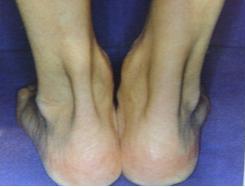
Bunion correction surgery is done by incision to the side of the big toe joint and the removal and realignment of the soft tissue and the bone. Bunion correction surgery is done for people looking for a long term relieving of pain to the foot and restore the normal alignment to the toe joint. Small screws are used to hold the bones in place.

  • Bunion correction surgery is done under general anaesthesia.
  • Bunion correction surgery usually takes an hour for each foot.
  • Bunion correction surgery can be done as a day surgery.

What to expect after a bunion correction surgery?

You can walk right away after the surgery. Some people may need crutches for the first few days.

  • Wound must be kept dry at all times.
  • Internal dissolvable stitches are used so there are no stitches to be removed.
  • Special shoes are sometimes worn by some patients.
  • Partial to full weight bearing can be put on foot.

Why bunion correction surgery is done?

  • Your bunion pain does not respond well to non-surgical treatments.
  • Bunion is painful and affects your daily activities.
  • Cosmetic purpose.

How well does bunion surgery works?

After the bunion is corrected, your daily activities like walking is likely to improve. The big toe joint will be generally less painful, and, in turn, moves better. Once the swelling and wound has settled down, your foot may look more normal than before.

You can see the following picture, the bunion at the right foot and the bunion correction surgery done to the left foot.

Before and After Bunion Corrective Surgery
Book Appointment Online for Bunion Correction Treatment

Improperly-fitting shoes, which can cause bunions, corns, calluses, hammertoes, and other disabling foot problems, are a huge public health risk. The following are statistics from the US, but are most likely applicable to Singapore, too, as a lot of women, for vanity’s sake are willing to endure punishment for their feet, in the name of fashion and beauty!

  • Nine out of 10 women are wearing shoes that are too small for their feet.
  • Eight out of 10 women say their shoes are painful.
  • More than seven out of 10 women have developed bunion, hammertoe, or other painful foot deformity.
  • Women are nine times more likely to develop a foot problem because of improper fitting shoes than a man.
  • Nine out of 10 women’s foot deformities can be attributed to tight shoes.

Bunions

The most common foot problems are bunions. Bunions are caused by wearing shoes that are too small. If the joint that connects your big toe to your foot has a swollen, sore bump, you may have a bunion.

Tailor's Bunion

More than half the women have bunions, a common deformity often blamed on wearing tight, narrow shoes, and high heels. If the painful swollen lump is on the outside of your foot near the base of your little toe, then it is called a bunionette (tailor’s bunion). An advanced bunion may make your foot look grotesque. If your bunion gets too severe, it may be difficult to walk. Your pain may become chronic and you may develop arthritis.

Arch Pain (Plantar Fasciitis)

Plantar fasciitis is one of the most common causes of heel pain. It is due to inflammation of a thick band of tissue called the plantar fascia, which is a fibrous band of tissue running from the heel to forefoot, along the bottom of the foot. Over or under pronation causes excessive shock to the foot when walking and running. The pain is localised in the heel and / or arch and is often extreme in the morning when first getting out of bed after prolonged rest. The chief diagnostic sign of this problem is pain at the bottom of the heel or arch when first standing, which gradually improves with walking. This pain may later return with continued walking. The pain usually subsides after a period of rest.

 Achilles Tendinitis

Achilles Tendinitis
Achilles Tendinitis

The Achilles tendinitis is a syndrome of irritation of the Achilles tendon in the ankle. The Achilles tendon is the large tendon in the back of the ankle that inserts into the heel bone. When individuals overuse their Achilles tendon, it becomes irritated and inflamed. This inflammation can cause pain and swelling and can lead to small tears within the tendon and make the Achilles tendon susceptible to rupture. This is often caused by repetitive, minor impact on the affected area, or from a sudden more serious injury. Incorrect posture at work or home or poor stretching or conditioning before exercise or playing sports also increases the risk.

Ingrown Toenails

Ingrown Toenail
Ingrown Toenail

An ingrown toenail occurs when a sharp corner of the toenail digs into the skin at the end or side of the toe. Pain and inflammation at the spot where the nail curls into the skin occurs first. The inflamed area then starts to grow extra tissue or drain yellowish fluid. Usually caused by tight-fitting shoes or high heels, the toes tend to get compressed together and pressurise the nail to grow abnormally. Improper trimming of toenails can also cause the corners of the nail to dig into the skin. Disorders such as fungal infections of the nail can also cause a thickened or widened toenail to develop.
Book Appointment Online for  Treatment

From symptoms to treatment to prevention, get the basics on bunions.

What is a bunion?

Bunion

A bunion is the bony prominence on the medial side of the big toe. It is a localised enlargement of bone and tissue on the sides and / or top of the joint at the base of the big toe. Bunion forms when the big toe (Hallux) is angled excessively towards the second toe. When this happens, the tendons no longer pull the toe in a straight line, so the problem tends to get worsen progressively.

Who develops bunions and why?

Bunions occurs more commonly in females than in males. This is likely due to biomechanical abnormalities in the foot and / or poor or ill-fitting footwear aggravates it. Females have a tendency to wear footwear that is too small. When young girls develop bunions, they are likely hereditary and tend to have hyper mobile foot joints.

Bunions are found in both populations who wear footwear and populations who do not wear footwear. But, symptomatic bunions are common in populations who wear footwear, especially fashionable footwear.

What are the symptoms of a bunion?

The area bony prominence (bunion) may be with or without pain symptoms. Callus and fissures may form as a result of pressure and friction during gait, and these can be painful or painless. Sometimes, a bursa (sac of fluid) can form and become inflamed and sore.

How is a bunion diagnosed?

A bunion is diagnosed through clinical presentation. X-ray will show a degree of angulation or deviation of the metatarsal and phalange bones but it is not warranted unless patient is heading for surgical treatment.

How are bunions treated?

Bunions, when formed, can only be removed surgically. However, surgery is usually the last option and opted only when they cause significant pain and discomfort and / or if deformity is severe enough to affect quality of life. Symptoms of bunions can be addressed conservatively. For example, paring of painful callus and fissures, and ensuring comfortable correct fitting footwear. Orthotics can address biomechanical issues such as execessive pronation or loading of the first metatarsal head. Orthotics can provide symptom relief and slow down the progression of the condition but it will not reverse the deformity.

Can bunions be dangerous in the long run?

Bunions are not dangerous in the long run.

The skin over it may be red and tender. Wearing any type of shoe may be painful. Use of covered shoes can be challenging. The joint is the major toe-off joint during gait so it can hurt with every step. Bunion can also cause other disabling foot problems like corns, calluses and hammertoes.

Over time as the big toe angles toward the second toe, it may move all the way under it or over it. Pressure from the big toe may also force the second toe out of alignment, sometimes overlapping your third toe.

The foot may loot grotesque or deformed in severe bunion. When this happen, and it usually happens over time, it may be difficult and painful to walk. Once the big toe joint is unable to function properly, balance will be affected.

How can bunions be prevented?

Prevention is always the best.

  • Avoid forcing your foot into a show that doesn’t fit.

Most people do not realise it when it happens because they tend to force themselves to “adapt” or “wear-in” in to the shoe.

It is always fashion and style over comfort. Usually when people ware in their twenties, they rarely feel pain or discomfort when they wear ill-fitting shoes. But, having no pain or discomfort does not mean that the foot is not undergoing torture for that to 8 to 10 hour period of use.

  • Choose shoes that conform to the shape of your feet.

Go for shoes with wide insteps, broad toe-box or toe-base, soft inlays and firm outsoles. Choose leather as they are softer and more comfortable. Avoid shoes that are short, tight or sharply pointed, and those with heels higher than one inch for daily use. High heels put more weight onto the ball of the foot, thus putting the forefoot and toes under more pressure. Also avoid slip-on shoes a they have to be tighter to stay on your feet. There is nothing to hold the foot in place so the toes often slide to the end where they are exposed to lots of pressure.

If you already have a bunion, wear shoes that are roomy enough to not put pressure on it. This should relieve most of your pain. One can also use protective pads to cushion the painful area. However, if the footwear is already tight or not roomy enough, then the bunion pads can cause more problem.

If the bunion has progressed to the point where one has difficulty walking, or experiences pain despite accommodative shoes, one may need surgery. Bunion surgery realigns bone, ligaments, tendons and nerves so the big toe can be brought back to its correct position. Orthopaedic surgeons use several technique for this surgical procedure.
Book Appointment Online for Bunion Treatment

Plantar fasciitis, also known as heel-spur syndrome is a widespread problem amongst people who are active in sports, particularly runners. It starts as a dull, intermittent pain in the heel. If not treated correctly, it will progress to a sharp, persistent pain.

Plantar Fasciitis

What is plantar fasciitis?

Plantar fasciitis is an inflammation of the plantar fascia, which is a thick band of tissue that runs from the heel of the foot to the toe. The pain is generally characterised as a dull, aching pain. In some cases, it can be a sharp, acute pain due to the inflammation.

What are the causes of plantar fasciitis?

The main cause of plantar fasciitis is due to overuse – such as running or standing all day. Teachers and factory supervisors who stand all day tend to get it due to increased pressure placed on the plantar fascia. We see it amongst long distance runners too. However, overuse is not enough to cause plantar fasciitis. We usually examine risk factors as well. One of them is the tightness of the calves, which is one of the leading causes of plantar fasciitis.

Another risk factor would be foot abnormalities. These include high arch foot (pes cavus) or flat-footedness (pes planus). In pes cavus, tension underneath the foot is going to be very high. With flat-footedness, the arch tends to collapse, creating a ‘windshield wiper’ effect. The bottom of the foot keeps rolling in, rendering it unstable.

Obesity is another reason – the extra weight can cause excess stress on the plantar fascia. Women may be more prone to develop plantar fasciitis due to long term use of high heels leading to tightening of the calves.

What are the signs and symptoms of plantar fasciitis?

Pain in the heel. This is most significantly felt in the mornings, during the first step of the day. Athletes, who run a lot, will feel it at the end of a run. The pain will be worse the following morning.

What can an athlete do to relieve the pain?

Painkillers can be taken or athletes can undergo the RICE therapy which is Rest, Ice Compression, Elevation therapy. It has an anti-inflammatory effect. The next step would be to reduce risk factors, which should be the highest priority. Daily stretching of the calves and the toes helps to stretch the plantar fascia, and bring some relief.

What are the other forms of treatment like for plantar fasciitis?

When the pain gets better. we start to strengthen the calves. Another way is to again look at reducing risk factors such as foot abnormalities.

Abnormal motion of the foot when walking such as overpronation, can be corrected with orthotic insoles, which we would get from a podiatrist to be custom made. A night splint is also used to keep the foot at 90 degrees angle to maintain the pressure on the plantar fascia. Cortisone injections are another form of approach in dealing with plantar fasciitis. It brings immediate relief but comes with side effects such as weakening of the tendons.

What is the rehabilitation process about for plantar fasciitis?

We start with the stretching and strengthening exercises. At more advanced levels, we move on to agility exercises like walking and running biomechanics as well as balance exercises. There has to be a certain degree of recovery before this stage can be reached.

What are the ways to prevent plantar fasciitis?

Plantar Fasciitis Stretching Exercise

Regular stretching exercises and strengthening of the calves are crucial when it comes to preventing plantar fasciitis. Use of appropriate footwear is also important.
Book Appointment Online for Plantar Fasciitis Treatment

Question: “I wear 3 inch heels everyday. Is this advisable? I have backaches but when I switch to flats, they worsen. What do I do?”

Wearing high heels on a daily basis can shorten your leg muscles and alter your posture. After a prolonged period of wearing heels, your muscles will adjust to this position. Once the muscles have adjusted to wearing high heels, wearing flat shoes can cause pain.

To reduce the pain in your back. It is important that you change the shoes slowly. Wearing high heels may feel more comfortable, but in the long term, it will cause more problems. I would advise wearing slightly lower heels for a few months, and performing calf muscle stretching 2 – 3 times a day to allow the leg muscles to adjust to the change. After 3 months, you should be able to slowly start wearing flat shoes. When wearing a flat shoe, however, do not choose those with a very thin sole like a ballet flat. Instead choose a shoe that has plenty of cushioning. If you are unable to make the change from high heels to more flat shoes, you should consult an orthopaedic specialist to have a proper foot and leg assessment as there may be other causes as to why you are experiencing pain when in flat shoes.

Call (+65) 80859224 to fix an appointment with our orthopaedic specialist, Dr. Kevin Yip, today.