psUpper LimbComments Off on Surgery for Tennis Elbow
Surgery for tennis elbow may involve:
Cutting (releasing) the tendon.
Removing inflamed tissue from the tendon.
Repairing (reattaching) tendon tears if it is possible to do so without overtightening the tendon.
Surgery may be done using arthroscopy, traditional open surgery, or a combination of the two techniques, depending on the type of problem and the method the doctor prefers to use.
Surgery can be done with general or regional anaesthetic and can be done as a day surgery or an overnight stay in the hospital.
Tennis Elbow
What To Expect After Tennis Elbow Surgery
Recovery varies from person to person.
Cigarette smoking slows tendon and wound healing.
Recovery depends on the amount of time and effort you put into a rehabilitation program.
You may not be able to keep doing the activity that caused your tennis elbow. Or you may have to make some changes to the way you do that activity in the future.
Why Surgery for Tennis Elbow Is Done
You and your doctor may consider surgery if:
You still have elbow soreness and pain after more than 6 to 12 months of non-surgical treatment.
Corticosteroid shots have given good short-term pain relief but the pain has returned.
You cannot perform daily tasks and activities because of elbow pain.
How Well Tennis Elbow Surgery Works
Various surgical procedures are used to treat tennis elbow.
Most people are able to return to their previous activities after tennis elbow surgery. Be sure to change any previous technique, equipment, or activity that has been linked to the elbow pain.
psUpper LimbComments Off on Osteoarthritis of the Knee
Brief Outline of Osteoarthritis Knee
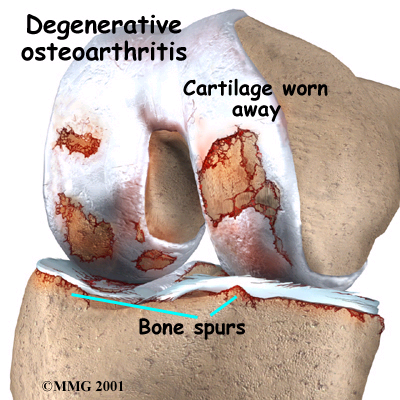
Osteoarthritis, or degenerative joint disease, is a progressive degenerative disease that wears away at the joint cartilage, which is a stiff connective tissue that allows for smooth movement as the knee joint flexes and extends, and which also acts as a shock absorber. As osteoarthritis progresses, the protective cartilage becomes thin and, in extreme cases, the ends of the bones can be exposed. Osteoarthritis of the knee is more common in patients who are over 50 and overweight.
Cause of Osteoarthritis Knee
Long-term repetitive overuse. Excessive weight or overloading of the knee joint. Previous injury to the knee, such as fracture or a meniscus injury.
Signs and Symptoms of Osteoarthritis Knee
Pain, swelling, and tenderness, especially during activity. Stiffness and limited range of motion. Crunching, grinding, and locking of the knee joint.
Complications if Left Unattended Osteoarthritis Knee
If left unattended the cartilage will degenerate to the point where the ends of the bones will be grinding on each other, at which point surgery will be the only option for relief.
Rehabilitation and Prevention for Knee Osteoarthritis
Osteoarthritis is an extremely difficult condition to reverse, so prevention is a high priority. All efforts should be made to reduce any excess body weight and modify any activities that put repeated stress on the knee joint. Improving the condition of the muscles around the knee with strengthening and stretching exercises will provide added support to the knee joint. Another alternative is to take glucosamine supplements, which may help to prevent further degeneration of the cartilage, and may even help to rebuild it.
Long-term prognosis and surgery
If prevention strategies are not initiated at an early stage, osteoarthritis of the knee may progress to the point where surgery is the only option. Depending on the severity of the condition, and the overall health of the patient, a number of surgical options are available. These range from knee arthroscopy, where the surgeon uses fibre-optic technology to look inside the joint and clean it of debris, to a total knee replacement.
psUpper LimbComments Off on Biceps Femoris Avulsion Fracture
Brief Outline of Biceps Femoris Avulsion Fracture
An avulsion fracture occurs when a tendon or ligament pulls away from the bone at its attachment, pulling a piece of the bone away with it. This usually results from a forceful, twisting muscular contraction or a powerful hyperextension or hyperflexion of the knee. The injury is more prevalent in children than adults: in adults the tendons or ligaments tend to tear before the bone is affected, whereas the softer bones tend to become involved in children’s injuries.
Cause of Biceps Femoris Avulsion Fracture
Forceful twisting, extension, or flexion, causing extra stress on the tendon. Direct impact on the knee, causing forceful stretching of the biceps femoris tendon.
Signs and Symptoms of Biceps Femoris Avulsion Fracture
Pain at the back of the knee. Swelling and tenderness. Loss of hamstring strength and decreased ability to flex the knee.
Complications If Left Biceps Femoris Avulsion Fracture Unattended
When left untreated an avulsion fracture will lead to long-term disability in the hamstrings and knee joint. Incomplete or incorrect healing may result as well, leading to future injuries of the knee and other muscles around the joint.
Immediate Treatment for Biceps Femoris Avulsion Fracture
R.I.C.E. Immobilisation of the knee joint. Anti-inflammatory medicines. Seek immediate medical help.
Rehabilitation and Prevention for Biceps Femoris Avulsion Fracture
Rest for the injured knee and then strengthening the muscles and supporting ligaments will help rehabilitate and prevent future fractures. Gradual re-entry into full activity is important to prevent re-injuring the weakened area.
Long-term Prognosis and Surgery for Biceps Femoris Avulsion Fracture
With proper treatment most simple avulsion fractures will heal completely with no limitations. In rare cases surgery may be needed to repair the avulsed bone, especially in children when the avulsion involves a growth plate.
psUpper LimbComments Off on Why is My Hand Painful?
Our hands are used almost unconsciously to get things done whether at work or at play. We seldom think about them until something is not quite right, and even then, we often push it our of mind until it becomes an obstacle to using our hands properly.
Some conditions can cause slowly progressing or chronic pain in our hands in the absence of any injury. Most can be treated and cured if diagnosed early; but if left untreated these conditions may cause significant disability. Three of the most common chronic painful hand conditions and their treatments are discussed.
Trigger finger is one of the most common painful conditions of the hand between the ages of 40 to 60. Along with pain, the affected fingers or thumb also become stiff and may “lock” when fully flexed. Straightening the fingers is difficult and accompanied by a clicking sensation. In more severe cases, one may have to use the other hand to pull the finger straight. The finger is especially stiff and prone to to locking just after waking in the morning. This condition is caused by a combination of repetitive stress on the flexor tendons of the fingers and ageing. The flexor tendons go through a tunnel along each finger. As we age, microscopic damage caused by daily friction between the tendons and the tunnel accumulates. The opening of the tunnel becomes thicker and tighter, making it more difficult for the tendon to move the finger. When the tendon gets stuck, the finger locks. The most reliable treatment is surgery to divide the tight opening of the tunnel, allowing the tendon to move freely again. Steroid injections to the tunnel are also useful, but there is a 30% chance that the condition will recur after an injection.
Trigger Finger Video
DeQuervain’s Tenosynovitis
This is an inflammation and tightness of the tendons going across the wrist to the thumb caused by overuse. Young mothers are very prone to this due to hormonal changes, inexperience with carrying a baby for breastfeeding, and having to hand-wash a lot of baby clothes. Office workers who use a keyboard and mouse for long hours with poor hand and wrist posture are also prone to this. The use of tablets and smartphones requiring a lot of thumb movements to type messages is nor also becoming common cause. This condition causes pain along the border of the thumb going into the wrist and the forearm, particularly with thumb and wrist movements. Simple actions like opening doors or bottles, brushing teeth, tying hair or hooking a bra can become impossible because of the pain. Even typing on a keyboard is painful when the thumb is used. In the early stages, resting the thumb and wrist in a splint or brace and taking anti-inflammatory tablets may cure the problem. However, once it has been present for more than a month, an anti-inflammatory injection to the tendons is needed. Most, importantly, long-term changes in the way the hand and thumb are used are essential to prevent the condition from recurring. If the injection doesn’t work or the pain keeps coming back, then surgery is needed to release the tendons from their tunnel at the wrist.
Carpal Tunnel Syndrome
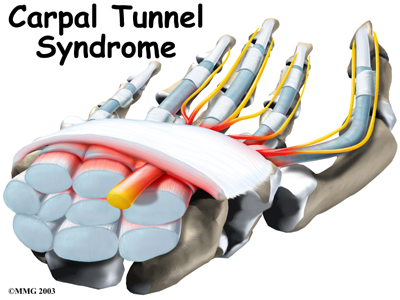
This is caused by excessive pressure on the median nerve as it goes across the wrist into the hand. The median nerve is the main nerve providing sensation in the hand and control of the thumb muscles. Along with the flexor tendons to the fingers, this nerve goes through a tunnel at the wrist, consisting of the wrist bones and a thick band of fibrous tissue across the top. The pressure in this tunnel increases as we grow older due to thickening of the tendons from repeated daily use. Other conditions such as wrist fractures, gout, and tumours may also increase the pressure in this tunnel. The increased pressure decreases blood flow to the nerve, impairing its function, resulting in numbness, tingling, and burning pain in the hand.
Symptoms are usually worse the morning on waking up, and sometimes can wake you from sleep. If left untreated, the nerve may become permanently damaged, with decreased sensation in the fingers and weakness of the thumb. Mild cases may resolve with resting in a splint, doing exercises for the nerve and taking high potency supplements. However, the best treatment is most cases is to decompress the nerve by cutting the band of tissue going across it. This is now done via keyhole or endoscopic surgery under local anaesthesia. Symptoms usually disappear within one to two weeks if operated on before permanent nerve damage occurs. In severe cases with permanent damage, recovery of lost function may be poor even with surgery, but surgery will prevent worsening function.
Timely surgical management can cure those common painful hand conditions.
psUpper LimbComments Off on Tennis Elbow and Golfer’s Elbow
These conditions cause pain at the points at which the tendon attaches to the bone around the elbow. Tennis elbow causes pain on the outer side of the elbow, where the extensor muscles on the outer side of the forearm are attached.
These muscles bend the wrist back and straighten the fingers. Golfer’s elbow is much less common and causes pain on the inner side of the elbow, at the attachment of the flexor muscles which bend the wrist forwards and flex the fingers.
Both conditions were first described in sportsmen but most sufferers develop them as a result of everyday activities, such as repeated heavy lifting, pushing and pulling. Sometimes a single episode of awkward lifting, such as lifting a heavy case down from an overhead locker, may be the trigger. The lifting need not be heavy: office workers who repeatedly pull files out of tight, over-stuffed cabinets are also at risk.
Treatment to Elbow Pain
Anti-inflammatory injection into the painful area is usually helpful. Physiotherapy may also be beneficial.
But most important is to work out what caused the problem in the first place and avoid the activity in the future, otherwise the symptoms may recur and can become chronic.