Key Points

  • If conservative treatments have not been successful and you experience pain and limited motion then surgery may be a therapeutic option for your osteoarthritis.
  • The posoperative rehabilitation process is often lengthy, and complications are possible – please give the decision to have surgery appropriate consideration.
  • A discussion with your doctor and then an informed decision aware of the potential risks and benefits of surgery should be made.

While most people with osteoarthritis won’t need surgery, it might be an option for you if you experience severe joint damage, extreme pain, or very limited motion as a result of your OA and other more conservative treatments have been unsuccessful. The decision to use surgery depends on several things including your level of disability, the intensity of pain, the interference with your lifestyle, your age, other health problems, and your occupation. Currently, more than 80 per cent of the surgeries performed for osteoarthritis involve replacing the hip or knee joint. An orthopaedic surgeon can assist you in determining if surgery is an option for you to relieve the pain from osteoarthritis.

Surgery may be performed to:

  • remove loose pieces of bone and cartilage from the joint if they are causing pain or symptoms of buckling or locking
  • resurface (smooth out) articular cartilage and bones
  • reposition bones (osteotomy)
  • replace joints

The benefits of surgery may include improved movement, pain relief, and improved joint alignment.

When should I have surgery?

Surgery should be resisted when symptoms can be managed by other treatment modalities. If your function and mobility remains compromised despite maximal conservative treatment, and/or if your joint is structurally unstable, you should be considered for surgical intervention. If your pain has progressed to unacceptable levels – that is, pain at rest and/or night-time pain – you should also be considered a surgical candidate. Thus the typical indications for surgery are debilitating pain and major limitation of functions such as walking and daily activities, or impaired ability to sleep or work despite other therapy.

What surgical options are there?

There are several different types of joint surgery.

Arthroplasty / joint replacement

Surgery may be used to replace a damaged joint with an artificial joint. Arthroplasty, or joint replacement surgery, is most often done to repair hips and knees, but also is used to repair shoulders, elbows, fingers, ankles and toes. Currently the most common indication for knee and hip replacement is osteoarthritis.

Joint replacement is one of the most successful procedures available in modern medicine, but still has its risks and potential complications.

Orthopaedic Surgeon

Dr Kevin Yip Orthopaedic Surgeon Gleneagles Singapore

DR KEVIN YIP

Book Appointment Online for Osteoarthritis Treatment

Injections are used to help in the management of osteoarthritis, but they are not a cure for the condition. They act by reducing symptoms such s pain and discomfort with the aim of improving function once more. As with other medicines, they should be used as a package, for example, alongside exercising or physiotherapy. The injections that we will cover in this article are called intra-articular injections – injections directly into the joint itself. They are therefore very different to the usual intramuscular injections (e.g. the flu jab) or subcutaneous injections (e.g. those used to administer insulin). There are two intra-articular injections commonly used in the management of osteoarthritis:

We will discuss these two injections and look at how effective they are, who they are suitable for, and potential side effects.

Corticosteroid intra-articular injections

Corticosteroids are hormones that are either produced naturally by the adrenal gland (found above the kidney) or produced synthetically. Most injection preparations are synthetic. They have various metabolic functions, but are used in osteoarthritis because of their potent ability to reduce inflammation. They were first used in the 1950s and to date most studies have concentrated on the knee joint, although there are some indications that it may also be beneficial for the hips. The vast majority of the research conducted with the knee joints confirms that corticosteroid injections are beneficial when compared to a placebo treatment. Today approximately 53% of doctors use these injections to help alleviate pain caused by osteoarthritis.

As mentioned earlier, the corticosteroid injection is not a cure for osteoarthritis but it can help relieve the pain and inflammation. The onset of pain reduction is usually rapid (between 24-48 hours) with the maximum effect being reached within a few days. Studies have shown that the benefits last up to 4 weeks in most subjects and up to 3 months in some patients who have effusions of the knee. They can be repeated up to four times per year for the knee joint although usually less often for hand joints. Research to date has not shown repeated injections to cause any deterioration of osteoarthritis in humans.

It is not uncommon following the injection to have a temporary, mild flare-up of knee pain occasionally accompanied by some inflammation. This is due to a natural reaction of the synovial fluid in the joint to the crystal steroid solution of the injection. It is usually an immediate side effect but it is not permanent, and the treatment for this is a cold compress.

Hyaluronic acid

Hyaluronic acid is a naturally occurring component of the synovial fluid and is also found in the cartilage. It is highly viscous and acts as a shock absorber within the joint. It also stores energy that can be released when there is rapid joint movement and acts as a lubricant when there is slower movement. It is thought it has a role in maintaining a healthy cartilage. In the osteoarthritic joint there is less naturally occurring hyaluronic acid and it can be less viscous.

By injecting hyaluronic acid directly into the joint the depleted levels are replenished and hence ease the pain and improve function of the joint.

Hyaluronic acid injections are not a cure for osteoarthritis, but they are used to help reduce the symptoms  (pain, swelling, stiffness). The benefits are usually noticed between 2 to 5 weeks, although this can vary. The benefits usually last about 6 months.

Orthopaedic Surgeon

Dr Kevin Yip Orthopaedic Surgeon Gleneagles Singapore

DR KEVIN YIP

Book Appointment Online for Osteoarthritis Treatment

  • Osteoarthritis (OA) is the most common type of joint disorder.

  • It is a chronic condition of the synovial joint causing pain and stiffness and sometimes inflammation and swelling.
  • It involves all of the structures of the joint.
  • It has a large individual impact due to effects on the quality of life as well as large socioeconomic consequences due to it being so common and costly.
  • It is important to understand as much as possible about the condition as this will help in future management of the OA.

Osteoarthritis Treatments

Besides oral medicines and physiotherapy, injection is another alternative besides surgery to treat osteoarthritis.

Lubricant injection that imitates the function of the synovial fluid of the joints is suitable for some patients.

Platelet rich plasma therapy injection also may help with the joint regeneration.

Surgery is another option if non-surgical treatments does not provide any relief anymore.

What is Osteoarthritis?

It is a chronic condition of the synovial joint that develops over time and is the result of damaging processes overwhelming the joint’s ability to repair  itself.

It can affect all of the joint tissues (including bone, ligaments, muscle, and synovium), not just cartilage. Many define OA as a condition that primarily affects hyaline articular cartilage. This cartilage is a troublesome thing that once destroyed, is not able to repair.

The Joints Affected by Osteoarthritis

The joints that are most prone to osteoarthritis include the hands and wrists as well as the weight-bearing joints of the body: the knee, hip and back. Other joints such as ankle, shoulder, and elbow are less likely to develop osteoarthritis unless there has been previous trauma to that joint.

What are the Signs and Symptoms of Osteoarthritis?

OA tends to come on slowly, over months or even years. The symptoms for those who have osteoarthritis consist of pain and stiffness (the latter is often relieved in a few minutes by movement) in the affected joints although they vary between individuals. Early in the disease course the pain is experienced with activity, although in later stages of disease it can occur at rest. In come cases the pain can lead to reduced movement, which in turn limits the function of the joint. In severe cases inflammation can develop, causing the joint to become swollen and warm. The signs that clinicians identify as part of the osteoarthritis condition include swelling, reduced range of motion, joint tenderness and bony enlargement around the joint, and crepitus (creaking of the joint when moved).

The Joint with Osteoarthritis

The synovial joint is made up of two bone ends, a layer of cartilage lining the end of each bone, a capsule lined by synovium which produces synovial fluid, ligaments, tendons and muscles.

Knee Anatomy

The role of cartilage, which healthy is usually  smooth, firm, white and rubbery in nature, is to help the bone ends move smoothly and painlessly against each other when the joint is moved.

Synovial fluid is a viscous fluid of a similar consistency to car engine oil and also helps the joint ends move easily by acting as a lubricant. A s a result we move joints naturally, often without noticing the action.

The tendons attach the muscles to bone and are involved in moving and stabilising the joints. The ligaments attach the two bones together and help to stabilise the joint at rest and during the movement.

The bone tissue and cartilage are always undergoing regeneration and as long as this continues the joints are work smoothly together. In osteoarthritis the damaging forces overcome the joint’s reparative ability.

The Joint with Mild Osteoarthritis

Mild Osteoarthritis Knee
The above figure shows a joint with mild osteoarthritis changes. As you will see, the cartilage over time has become thinner, scantier, and less smooth in appearance such that the two bones do not move as smoothly during joint movement. The space between the bone ends has also become narrower due to the thinning of the cartilage, and as a result more pressure is put on the tendons and ligaments to maintain joint stability. In response to the depleted cartilage and imbalance the bone starts to grow little bony spurs called ‘osteophytes’.

The Joint with Severe Osteoarthritis

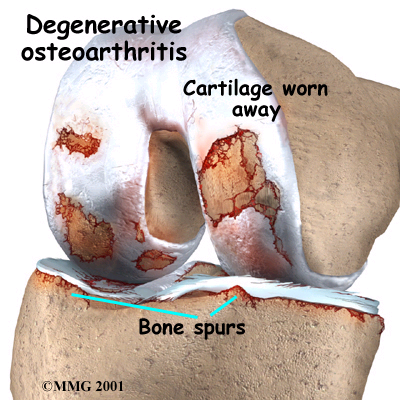
You an see in below figure that there is now much greater cartilage loss, including areas where the cartilage has disappeared, exposing the underlying bones. The osteophytes are now bigger and the bone ends start to thicken in response to the increased stresses that they encounter due to the loss of the shock-absorbing effect of the overlying cartilage. As the cartilage breaks down, debris can be found in the synovial fluid, which is struggling to produce enough lubricant for the bone ends and remaining cartilage.

Knee Osteoarthritis

This advanced stage of osteoarthritis results in pain, stiffness, and inflammation as the joint struggles to maintain its smooth function.

In Summary

Osteoarthritis is a chronic or long-term disease of the synovial joints associated with pain and stiffness. The impact and experience of osteoarthritis vary between individuals.

Orthopaedic Osteoarthritis Surgeon

Dr Kevin Yip Orthopaedic Surgeon Gleneagles Singapore

DR KEVIN YIP

Book Appointment Online for Osteoarthritis Treatment

Osteoporosis Screening Package @ $379

Package includes:

  • Bone Mineral Density Scan
  • Specialist Orthopaedic Consultation to interpret your result

What is Osteoporosis?

More common in women above the age of 50, osteoporosis usually comes with no symptoms and is also known as the “silent disease”.

Osteoporosis is a bone disease where the bone structure gets porous and weak. Losing density and mass, bones become more prone to fractures.

A reduction in mineral bone density if a normal part of aging after the age of 35. However, for some, this happens at a greater rate leading to osteoporosis. It affects women more than men on a ratio of 2:1. It is a silent condition as there are no symptoms until a fracture occurs often after a fall.

Osteoporosis can affect all bones in the body, however the areas that are most prone to fractures include hip, spine and wrist.

Osteoporosis
Osteoporosis

Osteoporosis Specialist

Dr Mathew Tung

Dr Mathew Tung Neurosurgeon

Book Appointment Online for Osteoporosis Treatment

The information provides advice on caring for your plaster cast, synthetic cast and splint. These applications help to immobilise an injured limb after fractures, sprains, ligament tears and other injuries.

Do’s:

  • Raise your injured part using pillows to reduce swelling.
  • Observe for change in nail bed colour of your injured part eg: from pink to blue.
  • Take painkillers when in pain.
  • Exercise your exposed fingers/toes of your injured part to prevent stiffness/swelling.
  • Keep your cast/splint clean and dry to prevent skin irritation.
  • Cover your injured part with plastic before a shower to prevent cast/splint from getting wet.
  • Use a fan to dry the inner cast/splint if it is wet or damp.

Do’s (Upper Limb)

  • Support your injured hand in an arm sling.

Arm Sling

Do’s (Lower Limb)

  • Always sit on a chair and place your injured leg on another chair when showering.
  • Use crutches/wheelchair as instructed for your own safety.

Don’ts

  • Do not put weight on the injured part unless advised by the doctor.
  • Do not wet your cast/splint.
  • Do not put powder or any object in your cast/splint.
  • Do not attempt to loosen or shorten your cast/splint.
  • Do not scratch your skin underneath your cast/splint using sharp object.

If you experience any of the following:

  • Swelling
  • Discolouration
  • Tingling sensation or numbness
  • Increasing Pain
  • Skin rubbing in the cast/splint or broken skin around the edges
  • Cast/splint feels too tight or loose, broken or cracked
  • Cast/splint is soaked or soiled

Book Appointment Online for Cast & Splint Treatment