The lumbar disc is comprised of an inner gel and an outer annulus. The lumbar discs provide stability and resiliency to the lumbar spine. Lumbar disc herniation develops because of a tear in the annulus of the lumbar spine; the inner nucleus pulposus extends beyond the tear, comprising a part of the spinal canal.
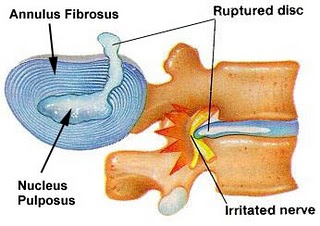
Prolapsed Intervertebral Disc

In many cases, lumbar disc herniation develops insidiously as a result of repeated, small micro tears that develop in conjunction with a degenerative disc. In these cases, patients with lumbar disc herniation may be completely without symptoms. Indeed, imaging studies have revealed that lumbar disc herniation may be present in a sizable number of individuals who have no symptoms.

Many patients with an acute lumbar disc herniations have symptoms of pain or numbness in conjunction with a pinched or compressed nerve. Acute lumbar disc herniation develops because of a sudden and large tear in the annulus, with subsequent rupture of nucleus pulposus material through the tear. Most of these herniations occur posteriorly, that is, toward the back. They also are generally to one side, but occasionally are midline.

If a disc herniation is initially midline, pain is perceived as a deep discomfort in the center of the lower back. Sometimes patients describe a sudden popping sensation. Other times, the patient senses that something is wrong in the lower back, but the pain may not be excruciating. Over days, the tear may enlarge and the disc herniation worsens while symptoms increase.

As a disc herniation enlarges, it generally does so to the right or left of midline. Often, it will compress the lumbar nerve root at that level. Most disc hernations develop between L4-L5, or L5-S1, which are the two lowest segments of the lumbar spine.

These two levels of the lumbar spine are the most mobile and vulnerable segments.
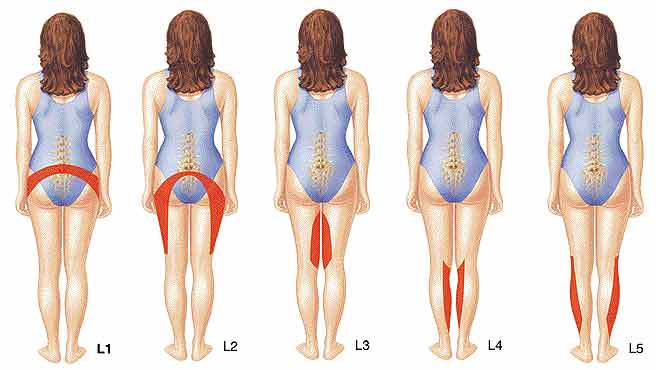
lumbar_herniated_prob_areas

When a nerve root is compressed, there may be associated pain, and pain will normally be perceived in the sensory distribution of that nerve. For example, a herniated disc at L4-5 may compress either the right or left L5 nerve root, which may cause pain radiating down the right or left side of the leg and into the great toe. IF the nerve is severely compressed, there may be numbness (corresponding to the same sensory distribution) or muscle weakness. This demands urgent medical attention.

Patients with acute lumbar disc herniation typically are comfortable lying on their back with knees flexed. Sitting is often uncomfortable, and standing may or may not be comfortable. Patients generally avoid bending forward, and sudden coughing or sneezing can worsen symptoms.

Cause of Lumbar Disc Herniation

The cause of acute lumbar disc herniation is not always apparent. Patients with chronic, degenerative lumbar discs and associated disc herniations often have a genetic predisposition to such degenerative changes. Otherwise, lumbar disc herniations generally occur in the setting of repeated overuse of the lumbar spine or sudden, more severe overuse. In this case, it is not simply the supporting musculature that gives, but the stabilising force of the lumbar spine itself.

Imaging and Diagnostic Studies

Plain X-rays is more for excluding other causes of back and radiating leg pain.

Magnetic Resonance Imaging (MRI) is the diagnostic study of choice for lumbar disc herniation. MRI is recommended if the doctor suspects a large disc herniation. MRI should be obtained if the lumbar disc herniation that is not improving with nonsurgical treatment over a few weeks.

Treatment Considerations

Summary Points

  • Lumbar disc herniation often develops gradually because of a genetic predisposition to degenerative disc changes.
  • Sudden lumbar disc herniation can cause severe pain and sometimes causes leg numbness and weakness.
  • Incontinence or severe leg weakness from lumbar disc herniation needs to attend immediately by an orthopaedic surgeon for decompressive spine surgery.
  • Most cases of lumbar disc herniation can be managed nonsurgically; over the long term, most patients can return to full activity.
  • Patients who develop lumbar disc herniation should try to reflect on significant life stressors that may predispose to spine imbalance.

Book Appointment Online for Lumbar Disc Herniation Treatment

Acute lumbar strain is probably the most common cause of low back pain. Typically, patients present with a rather sudden onset of pain that is localised to one side of the lower back or sometimes diffusely across the lower back. Pain may radiate into the buttock region and rarely into the leg, but usually the pain is localised to the lower back.

Most patients develop lumbar strain as part of an overuse pattern. That is, either the patient has repetitively engaged in an activity for which the lumbar spine is inadequately prepared, or the patient has engaged in a more sudden strenuous activity that overloads the normal muscular support structure of the lumbar spine. Typically, patients are more comfortable lying down or sitting and feel increased pain when standing or, especially, with certain bending motions of the spine.

Cause of Lumbar Strain

Although the exact cause of lumbar strain is not completely clear-cut, a pattern generally occurs in which supporting, musculature of the lumbar spine is relatively underdeveloped relative to the demands placed on it. This leads to a situation of muscle fatigue that increases vulnerability for a sudden stretch or tear of the muscle, possibly with associated spasm.

Imaging and Diagnostic Studies

A plain X-ray may reveal evidence of muscle spasm by way of straightening of the normal curvature of the spine.

MRI is needed if there is doubt as to the diagnosis or if the symptoms persist.

Treatment Considerations for Lumbar Strain

Summary Points

  • Lumbar strain is most common cause of low back pain; it is usually short-lived and self-limited.
  • Most patients develop lumbar strain because of physical imbalance, emotional imbalance, or both.
  • Muscle relaxants, spinal manipulation, and hands-on physical therapy are effective treatments for lumbar strain.

Book Appointment Online for Lumbar Strain Treatment

Our fondness for driving goes hand-in-hand with our tendency to shy away from exercise. Often, we will hop in the car, rather than walk down to the shops or to school or work. Whilst this may save us time, in the long term it may also increase our chances of developing back problems and other health problems  It is well known that people who lead active lifestyles are less likely to die early, or to experience major illnesses such as heart disease, diabetes and colon cancer.

Unfortunately for some people, spending long periods of time sitting in a car is unavoidable (e.g. taxi drivers, bus drivers, salespeople). The constant vibration of the wheels on the road, hunching over or gripping the steering wheel, sitting in the same position and stretching to depress the clutch or see out of the mirror, all take their toll on your back. It;s not just the driver who can stiffen up in a car either – passengers are often seated for long periods of time in a fixed position.

If you do spend a lot of time in your car, there are a number of things you can try to make yourself more comfortable:

  • bring your seat forward so that you can depress the clutch without having to stretch
  • adjust your mirrors properly
  • take regular breaks, ideally once an hour
  • try to avoid twisting when getting into or out of the car
  • keep a small cushion in the car to support your lower back
  • choose a car that is suited to your needs.

Choosing the Right Car

The Praying Test – Place both hands together, pointing forwards. You should be pointing straight at the centre of the steering wheel.

The First Test – Make a fist with your left hand, keeping the thumb to the side of the index finger. If you have sufficient headroom then it should be possible to insert the fist on the crown of the head.

The Right Leg Test – After driving the car for a short while, look down and examine the position of your right leg. Your right foot should still be roughly in line with your right thigh.

The Kerb Height Test – Swing your right leg out of the car as though you are getting out, and place your right foot on the ground. The surface of your right thigh should be sloping downwards (not upwards) towards your right knee.

These tests should only be performed then the are is stationary and carefully parked.

What is Decompressive Laminectomy for Lumbar Spinal Stenosis?

Decompressive laminectomy is the most common type of back surgery done to treat low back – spinal stenosis. Laminectomy is done to relieve pressure on the spinal nerve roots caused by degenerative changes in the spine. It is also done to treat other spine conditions such as, spine injuries, slipped disc, herniated disc or tumours. The aim of the surgery is to reduce the pressure to the nerve roots so as to relieve your pain and allow you to return to your normal daily activities.

Laminectomy removes parts of the bone or thickened tissue that is narrowing the spinal canal or pressing the spinal nerve roots. Laminectomy involves a small incision to the back.

What To Expect After Decompressive Laminectomy

Recovery of the surgery is gradual.

Why Decompressive Laminectomy Is Done

Decompressive laminectomy for lumbar spinal stenosis is considered when:

  • Severe back pain symptoms has affect your day to day activities.
  • Tried all conservative (nonsurgical) treatments but the symptoms persist. Numbness and weakness to the legs gets worse and not getting better.
  • You cannot walk very well.
  • Bladder and bowel control may be affected.

How Well Decompressive Laminectomy Works

The surgery has good results and you will see the result the next day of the operation. The symptoms will be reduced significantly.

What To Think About for Decompressive Laminectomy

You may want to exhaust all nonsurgical treatments before choosing surgery.

One can try the below conservative treatments before proceeding to the surgery.

Book Appointment Online for Decompressive Laminectomy for Lumbar Spinal Stenosis Treatment

You may need to consider surgical intervention for your back problem that is caused by a tumour or infection.

Removal of Spinal Tumours

Spinal tumours are growths found on the bones and ligaments at the spine, the spinal cord or on the nerve roots. The tumours can be benign (noncancerous) or  malignant (cancerous). During the surgery, the surgeon will remove the tumour or any bone that has damaged.

If some parts of the spine is affected by the disease and needs to be removed, the surgeon can use metal implants, bone grafts or bone cement to make your spine stable.

There are certain types of tumours which you can ignore. However, it is important to speak to a doctor to ascertain that the risks involved is minimum. Get advice from a surgeon who is an expert in treating spinal tumours.

Debridement of the Spine

This surgery is usually recommended for patient who has infection or injury to the spine. Debridement of the spine involves removing parts of the bone or other soft tissues that are infected.

The surgeon will remove the infected and damaged dead bone. The area is then cleaned with sterile solution that contains antibiotics. If the spine is severely affected and requires to remove a lot of the bones or entire vertebrae, he or she may use the spinal fusion (arthrodesis) method to stabilise the spine.
Book Appointment Online for Back Surgeries Treatment